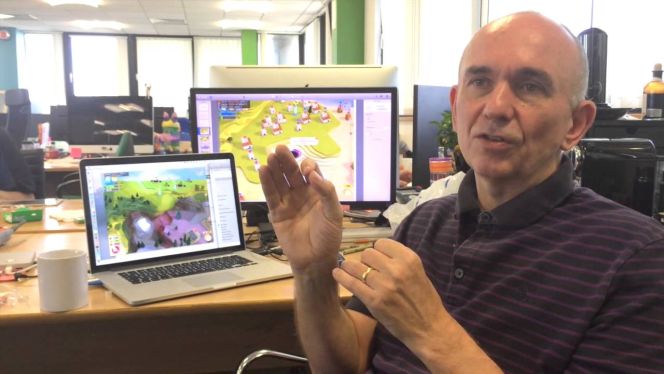
No figure in gaming embodies the tension between visionary ambition and shattered expectations quite like Peter Molyneux. Once hailed as a godfather of god games, his legacy now carries the weight of broken promises—and real financial consequences for those who believed.
His later ventures, particularly the crowdfunded Godus, didn’t just fail to deliver on their grandiose promises. They left behind a trail of disillusioned backers, frustrated developers, and investors nursing significant losses. This isn’t just about a game that underperformed. It’s about a pattern of overpromising that cost people money, time, and trust.
Here’s who paid the price.
The Crowdfunding Backers: Thousands Who Funded a Dream
When Godus launched on Kickstarter in 2012, it raised over $870,000 from 16,000 backers. The pitch was intoxicating: a god game that evolved in real-time based on player behavior, with persistent worlds, terraforming, procedural narratives, and even player-to-player conflict. Backers at higher tiers expected physical rewards, exclusive access, and even the chance to influence core game design.
But the delivered product bore little resemblance to the vision. The final release in 2014 was a bare-bones, single-layered god sim with simplistic mechanics and no multiplayer. Stretch goals were quietly abandoned. Promised features like “the Afterlife,” “multiplayer wars,” and “player-driven narratives” never materialized.
For many backers, this wasn’t just disappointment—it was a financial loss.
- A $100 pledge bought “Founder” status, a physical art book, and a personal thank-you from Molyneux. The art book eventually shipped, years late. The rest of the experience felt hollow.
- Some backers pre-purchased “lifetime updates” and additional content packs, only to see development slow to a crawl.
- Others used the game as a test case for supporting indie innovation. They lost faith in the platform’s accountability.
One backer on Reddit summed it up: “I didn’t just lose $80. I lost faith in the idea that creators owe anything to the people who fund them.”
The Developers: Talent Trapped in a Failing Vision
Behind the scenes, the human cost was even steeper. The team at 22cans, Molyneux’s post-Lionhead studio, worked under intense pressure to deliver an ever-expanding vision. Employees reported long hours, shifting priorities, and constant rework as Molyneux iterated on ideas without technical grounding.
Insiders describe a culture of “hope-based development”—building around what Molyneux wanted the game to be, not what was feasible.
- Junior programmers were assigned to prototype features that were scrapped the next week.
- Artists created elaborate assets for mechanics that never shipped.
- The engineering team struggled to scale the game for multiplayer, only to have the feature repeatedly deprioritized.
Multiple developers left the project mid-cycle, citing burnout and frustration. One former 22cans employee, speaking anonymously, said: “We weren’t making a game. We were chasing a mirage. The funding gave us runway, but the goal kept moving.”
When Godus Wars, a standalone multiplayer offshoot, was quietly canceled in 2016, it confirmed what many suspected: the project was unsustainable.
The Investors: Where Did the Millions Go?
Kickstarter raised $870,000—but that wasn’t the full picture. 22cans also secured a significant private investment round, rumored to be in the multi-million dollar range, from undisclosed tech and gaming investors.
These weren’t casual fans. They were venture backers expecting a scalable product, not an experimental art project. And by 2017, Godus had stalled. Player counts dwindled. No sequel or spinoff gained traction. The studio pivoted to mobile (Curiosity++) and AI-driven experiments, but none achieved commercial success.
For investors, the return was near zero. The failure of Godus didn’t just burn goodwill—it damaged 22cans’ credibility as a viable studio. Startups live or die by momentum. Godus had the opposite: entropy.
One industry analyst, who reviewed early pitch materials, noted: “The business plan assumed Godus would become a platform, like Minecraft. But without the core gameplay loop or community stickiness, that was never going to happen. The investors mistook Molyneux’s name for market demand.”
Lionhead Studios: The Casualty of Overpromising Before 22cans, there was Lionhead Studios—the studio Molyneux co-founded and led for nearly two decades. It was acquired by Microsoft in 2006 for a reported $10 million, with the goal of producing flagship exclusives for Xbox.
But the seeds of decline were sown through repeated overreach.
Fable II (2008) and Fable III (2010) delivered on charm but were criticized for simplifying gameplay and prioritizing spectacle over depth. Fable: The Journey (2012), a Kinect-exclusive title, was widely panned as a cash grab.
When Godus began consuming Molyneux’s attention, Lionhead faltered. Microsoft pulled funding in 2016 and shut the studio down, laying off 38 employees.
For the team at Lionhead, Molyneux’s legacy wasn’t just broken promises to fans—it was the collapse of their workplace. Many developers lost long-term careers. Others had to relocate or shift industries. The studio’s closure was a direct result of declining output and credibility, both tied to a culture of ambitious but undeliverable design.
As one ex-Lionhead designer put it: “We kept betting on Peter’s next big idea. But after a while, no one believed the pitch deck anymore.”
The Publishers: Microsoft’s Costly Gamble
Microsoft didn’t just acquire Lionhead—they tied their brand to Molyneux’s reputation. And when Fable stopped evolving and Godus became a cautionary tale, it reflected poorly on Xbox’s creative direction.
Microsoft invested heavily in marketing Molyneux as a visionary. His keynotes, his TED talks, his GDC appearances—all positioned him as a thought leader. When that persona cracked, so did trust in Microsoft’s ability to identify and support top-tier talent.
The closure of Lionhead wasn’t just a financial write-off. It was a strategic retreat from a failed creative partnership. Microsoft had banked on Molyneux delivering the next Minecraft-level phenomenon. Instead, they got a studio shutdown and a PR headache.
Today, the Fable franchise is being rebooted—but by a different studio (Playground Games). Microsoft’s lesson? Vision without execution is a liability.
/cdn.vox-cdn.com/uploads/chorus_image/image/70269281/112379621.0.jpg)
The Broader Industry: A Warning for Crowdfunding
The fallout from Molyneux’s failed legacy extends beyond individuals. It reshaped how the gaming industry views crowdfunding and celebrity-led development.
Before Godus, big-name developers could launch Kickstarters with minimal prototypes and still raise millions. Afterward, platforms and backers grew skeptical.
- Double Fine’s Broken Age faced similar delays, but at least delivered a finished product.
- Shenmue III raised $6.3 million but was criticized for not meeting expectations.
- Bloodstained: Ritual of the Night succeeded by under-promising and over-delivering.
The Godus case became a textbook example of “Molyneux Syndrome”—a term coined by developers to describe the danger of overselling a game’s potential. Studios now include detailed roadmaps, scope limitations, and regular dev logs to build trust.
Platforms like Kickstarter added new guidelines for video game campaigns, requiring clearer disclosures about risks and team experience.
Why This Pattern Keeps Repeating
Molyneux isn’t uniquely dishonest. He’s uniquely passionate—and that passion blurs the line between vision and reality.
At GDC 1996, he demoed Black & White with a creature that learned from player behavior. The final game didn’t deliver that level of AI, but the dream sold millions. That same pattern repeated with Spore, Dungeon Keeper, and finally Godus.
The problem isn’t ambition. It’s accountability.
- There’s no penalty for missing stretch goals on Kickstarter.
- Publishers rarely claw back bonuses for undelivered features.
- Fan communities forgive celebrities more easily than unknown devs.
And so, the cycle continues. Visionaries promise the moon. Backers fund it. And when gravity wins, someone else pays the price.
Who’s to Blame? Everyone and No One Assigning blame is messy.
Molyneux admits he “over-promised.” But he also argues that game development is inherently uncertain. He wasn’t scamming—he was believing his own hype.
Backers knew the risks of crowdfunding. Yet many ignored them, swayed by nostalgia for Populous and Black & White.
Investors bet on a name, not a business model. And Microsoft trusted a creative lead without enforcing delivery benchmarks.
The real failure wasn’t a single person. It was a system that rewards hype over honesty—a system that still exists.
The Path Forward: Transparency Over Hype
The lesson isn’t that bold ideas are bad. It’s that they must be grounded in reality.
Developers who succeed today—like the teams behind Valheim or Stardew Valley—share progress openly. They delay launches rather than ship broken products. They under-promise and build trust incrementally.
For backers, the rule is simple: judge the team, not the trailer. Look for studios with a track record of shipping. Demand clear roadmaps and scope definitions.
And for industry leaders? Stop glorifying the “visionary” who can’t deliver. Reward the quiet builders who ship, support, and iterate.
Peter Molyneux’s legacy is a cautionary tale—not because he failed, but because so many believed without proof. The players who lost money didn’t just lose cash. They lost a lesson: in gaming, as in life, promises are cheap. Results are everything.
FAQ
Did Peter Molyneux refund Godus backers? No, there were no widespread refunds. Some physical rewards eventually shipped, but digital promises were not honored.
How much money did Godus raise? Over $870,000 on Kickstarter, plus an undisclosed multi-million dollar private investment.
Why did Microsoft shut down Lionhead Studios? Due to declining performance, lack of successful releases, and strategic shifts at Microsoft.
Is Godus still playable today? Yes, but it’s no longer updated. The multiplayer component was canceled.
Has Peter Molyneux admitted fault? Yes, he’s publicly stated he “over-promised” and learned from the experience.
What happened to the Godus team? Many left 22cans. The studio shifted focus to smaller projects and AI experiments.
Does Molyneux still work in gaming? Yes, through 22cans, though he no longer commands the same industry influence.
FAQ
What should you look for in The Players Burned by Peter Molyneux’s Broken Promises? Focus on relevance, practical value, and how well the solution matches real user intent.
Is The Players Burned by Peter Molyneux’s Broken Promises suitable for beginners? That depends on the workflow, but a clear step-by-step approach usually makes it easier to start.
How do you compare options around The Players Burned by Peter Molyneux’s Broken Promises? Compare features, trust signals, limitations, pricing, and ease of implementation.
What mistakes should you avoid? Avoid generic choices, weak validation, and decisions based only on marketing claims.
What is the next best step? Shortlist the most relevant options, validate them quickly, and refine from real-world results.