Every year, hundreds of workers suffer serious injuries—or worse—because machinery was accidentally energized during maintenance. A conveyor belt kicks on mid-repair. A press lowers unexpectedly. A valve opens, releasing steam. These aren’t freak accidents. They’re preventable failures—often rooted in poor energy control practices.
That’s where Lockout Tagout (LOTO) comes in. It’s not just a procedure. It’s a system. A disciplined process that ensures machines are de-energized, isolated, and verified before any maintenance or servicing begins. When done right, LOTO saves lives. When ignored or misapplied, it leads to catastrophic outcomes.
Despite its importance, LOTO is frequently misunderstood, inconsistently applied, or treated as a box-ticking exercise. The result? Complacency, shortcuts, and near-misses piling up until something gives.
Let’s break down what LOTO truly means, how it works in practice, and what separates compliant programs from truly effective ones.
The Core Purpose: Controlling Hazardous Energy
LOTO exists to control hazardous energy. That includes electrical, mechanical, hydraulic, pneumatic, chemical, thermal, or gravitational energy sources that can injure workers during equipment servicing.
Imagine a mechanic working inside a large industrial oven. Even if the power is off, residual heat or an automated restart could be deadly. Or consider a hydraulic press: stored pressure in lines can cause sudden movement long after shutdown.
LOTO isn’t about turning off a machine. It’s about proving it can’t start up—and proving it stays dead—until work is complete.
OSHA defines the standard in 29 CFR 1910.147, which outlines the requirements for controlling hazardous energy. The rule applies to any equipment that could unexpectedly energize, start up, or release stored energy.
How LOTO Works: A Step-by-Step Breakdown
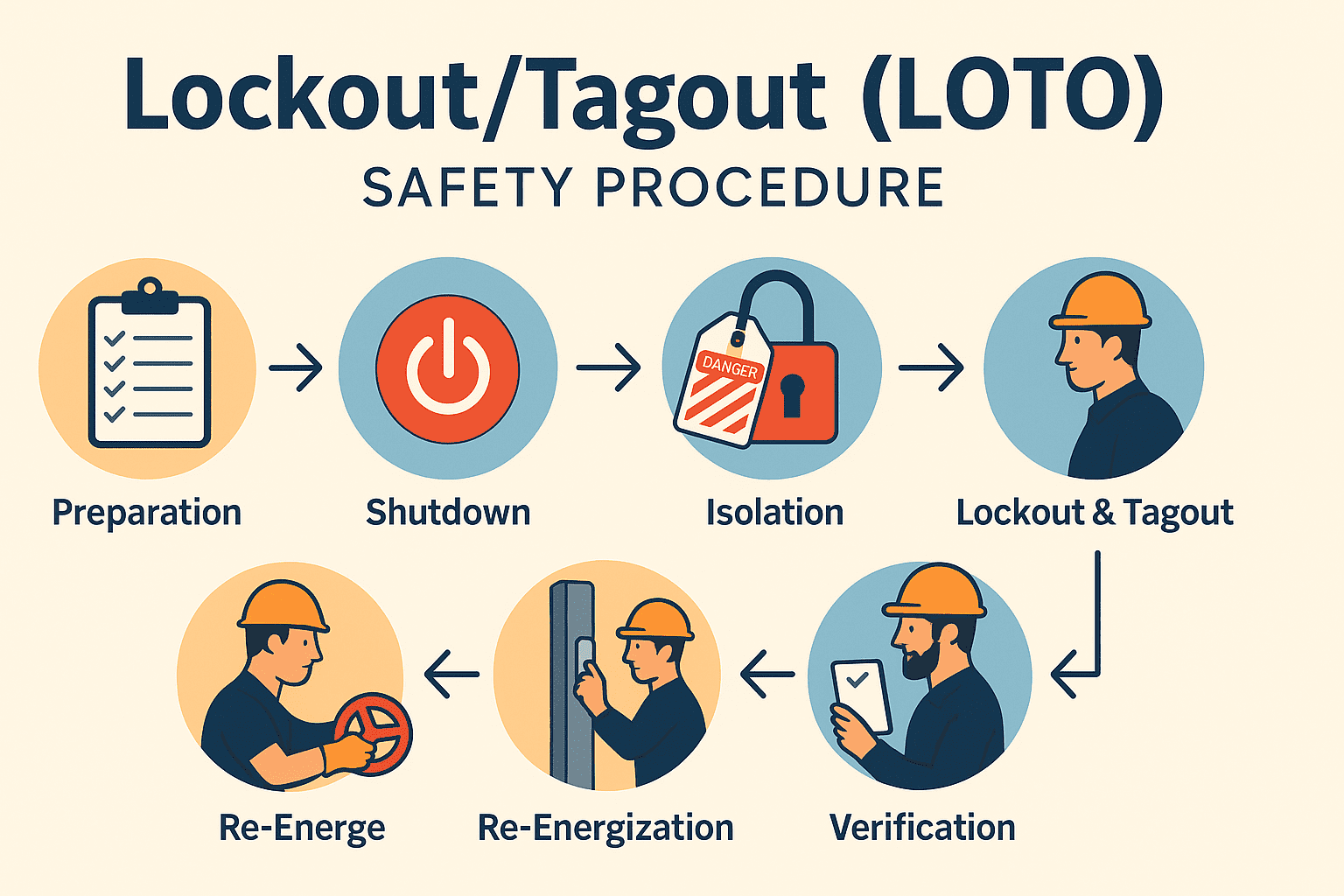
A successful LOTO procedure follows a strict sequence. Deviations increase risk. Here’s how it should unfold:
1. Preparation Before any work begins, the authorized employee must identify:
- The type and magnitude of energy involved
- The isolation points (e.g., circuit breakers, valves)
- The correct lockout devices needed
Example: Servicing a conveyor system might require isolating both the motor disconnect and the tensioning mechanism’s hydraulic valve.
2. Notification Warn affected employees that maintenance is about to begin. This isn’t just courtesy—it’s a safety layer. Everyone nearby needs to know the machine is going down.
3. Machine Shutdown Use normal stopping procedures. Press the emergency stop? No. That’s not a shutdown method. Shut down means following the correct operational sequence to bring the machine to rest.
4. Isolation Physically disconnect energy sources. Flip breakers. Close and secure valves. Block moving parts.
This is where most failures happen. Workers skip valves. They assume a switch is off when it’s not locked. Or they fail to bleed pressure lines.
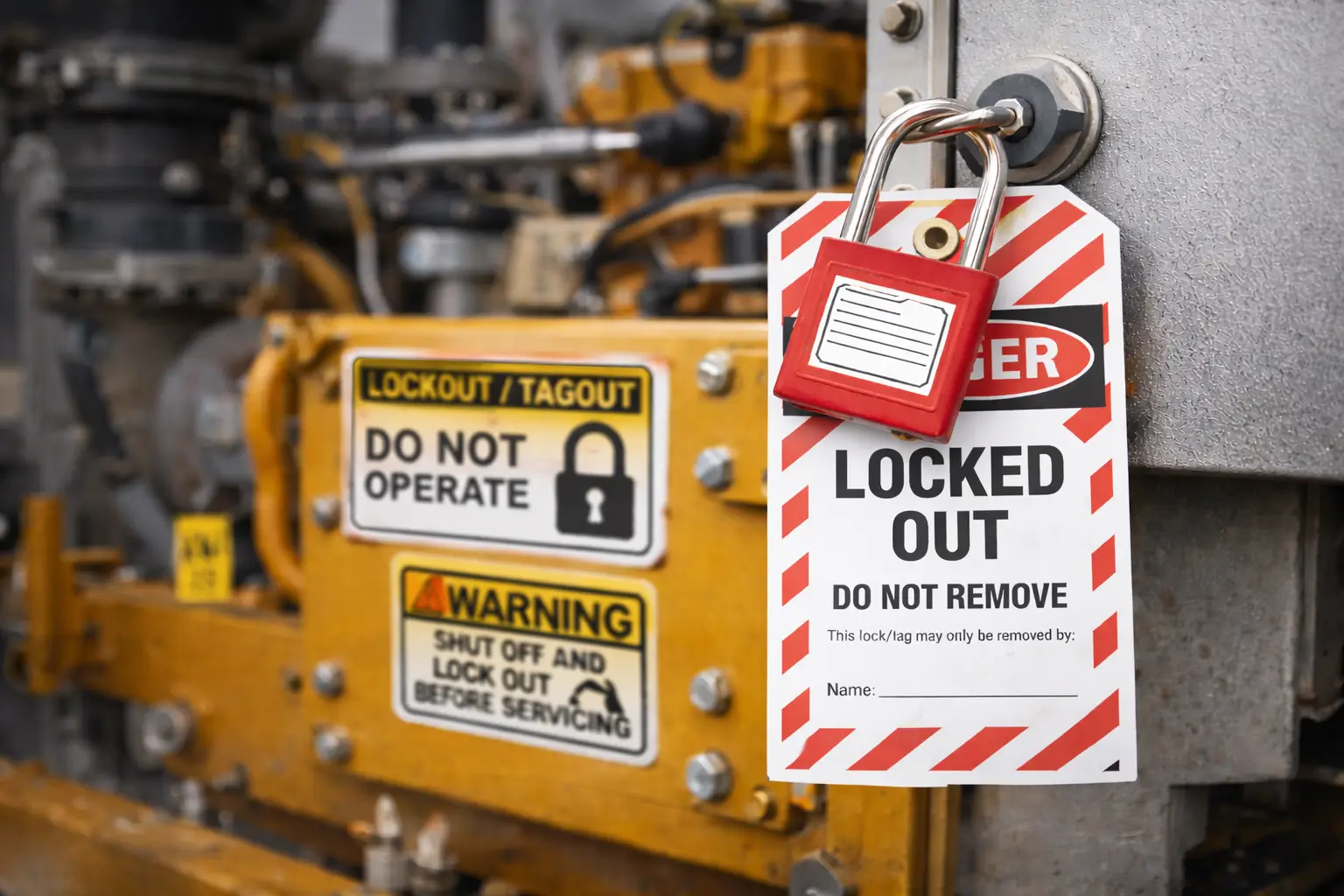
5. Application of Locks and Tags Each authorized worker applies their own lock and tag. This is non-negotiable. One person, one lock. Group lockout boxes are acceptable—but only if each individual still applies their personal device.
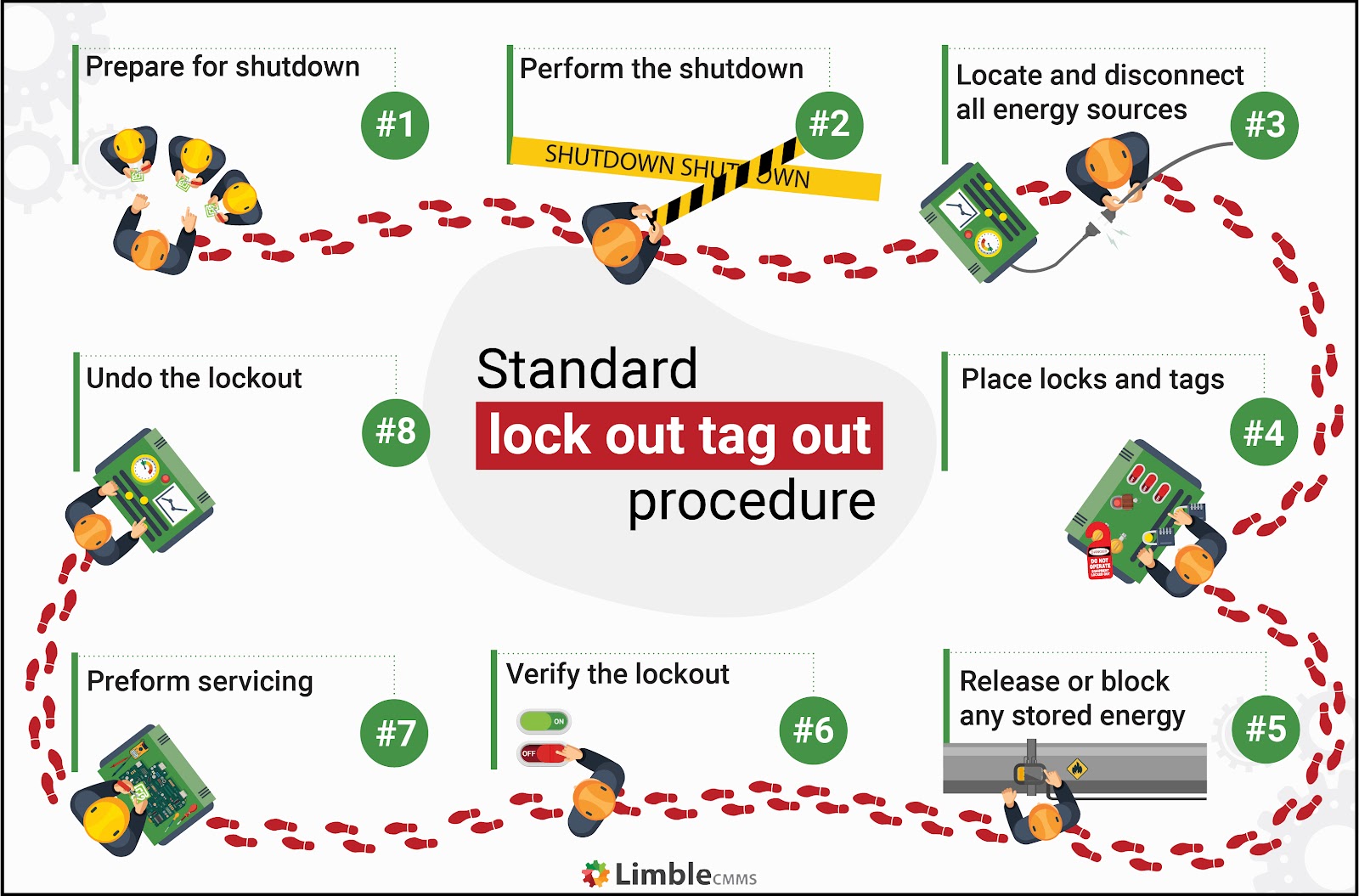
Tags must include: - Name of the person locking out - Date and time - Reason for lockout
A tag without a lock is not LOTO. It’s just a warning.
6. Release of Stored Energy
This step is often overlooked. Residual energy doesn’t vanish when power is cut. Springs may be under tension. Capacitors can hold a charge. Hydraulic lines stay pressurized.
Workers must bleed, block, or dissipate that energy safely—before touching anything.
7. Verification of Isolation Now comes the critical check: Attempt to start the machine. Turn the switch. Press the start button. Do it carefully, from a safe position.
If nothing happens—good. If it moves or powers up, stop. Re-evaluate. Something was missed.
Only after positive verification is the machine safe to work on.
8. Restoration Once work is done, the reverse process begins—but only after:
- Tools are removed
- Guards are reinstalled
- The area is clear
- All employees are notified
Only the person who applied the lock can remove it. No exceptions.
Common LOTO Mistakes (And How to Fix Them)
Even companies with LOTO programs make preventable errors. Here are the most frequent—and dangerous—mistakes:
Mistake 1: Using Tags Without Locks Tags are informational. Locks are physical barriers. A tag can be ignored. A lock cannot.
Fix: Mandate lock use. Tags alone don’t comply with OSHA.
Mistake 2: Shared or Master Locks Giving a supervisor a “master” key to remove locks defeats the entire purpose. The person who applied the lock must be the one to remove it.
Fix: Eliminate master keys for LOTO. Use group lockout boxes if multiple people are involved.
Mistake 3: Skipping Stored Energy Release Workers assume “off” means safe. But a disconnected circuit can still hold a lethal charge.
Fix: Include stored energy checks in every procedure. Test before touch.
Mistake 4: Incomplete Procedures Generic LOTO steps don’t work for complex machines. A one-size-fits-all approach fails when equipment varies.
Fix: Develop machine-specific LOTO procedures. Include diagrams, energy sources, and step-by-step instructions.
Mistake 5: Poor Training Affected employees often don’t understand their role. They restart equipment not realizing it’s locked out.
Fix: Train both authorized and affected employees. Test understanding regularly.
Who Needs LOTO Training?
OSHA distinguishes between two roles:
- Authorized employees: Those who perform servicing and apply LOTO. They must be trained on procedures, energy types, and verification.
- Affected employees: Those who operate or use equipment but don’t service it. They need to know what LOTO is, why it’s used, and not to interfere.
Training must be documented, repeated annually, and updated when procedures change.
LOTO Devices: What Works Best
Not all locks and tags are equal. The right equipment ensures reliability and compliance.
Lockout Hasps Allow multiple locks to be applied to a single isolation point. Essential for group work.
Valve Lockouts Secure ball valves, gate valves, or needle valves to prevent accidental opening.
Circuit Breaker Locks Slide over breaker switches to prevent re-energization.
Plug Lockouts Prevent electrical plugs from being reinserted.
Breaker Lockout Boxes Secure multiple breakers or control panels. Often used in electrical rooms.
Tags Must be durable, non-reusable, and clearly labeled. Include space for name, date, and purpose.
Choose devices that match your equipment and environment. In wet areas, use corrosion-resistant materials. In high-heat zones, ensure plastic components won’t deform.
When LOTO Isn’t Enough: Alternative Controls
Not every minor task requires full LOTO. OSHA allows exceptions under specific conditions—like minor tool changes or routine production work.
But these exceptions are tightly defined. For example: - The task must be part of normal production - It must be repetitive and integral to operation - Risk must be minimal - Alternative protective measures (like point-of-operation guarding) must be in place
Never use this exception as a loophole. If the task involves reaching into danger zones, LOTO likely still applies.
Real-World LOTO Failure: A Case Study
In 2022, a worker at a food processing plant was clearing a jam in a conveyor system. He turned off the control but didn’t lock out the main disconnect. Another employee, unaware of the work, restarted the line remotely.
The outcome: the worker lost two fingers.
Investigation revealed: - No formal LOTO procedure for that machine - Worker wasn’t trained as “authorized” - No lockout devices were available nearby
This wasn’t an anomaly. It was a cascade of failures—one that could have been prevented with basic LOTO discipline.
Building a Reliable LOTO Program
Compliance isn’t just about passing an audit. It’s about creating a culture where safety is non-negotiable.
Here’s how to build a robust system:
1. Inventory Your Equipment List every machine that requires servicing. Identify energy sources and isolation points.
2. Write Machine-Specific Procedures Don’t rely on general steps. For each machine, detail: - Energy types - Isolation methods - Lockout points - Stored energy release steps
Include photos or diagrams if possible.
3. Audit Regularly Observe LOTO in action. Are workers skipping steps? Are tags missing information? Use audits to catch drift before it leads to incident.
4. Empower Workers Make it easy to do the right thing. Place lockout stations near equipment. Provide personal lock sets. Encourage reporting of close calls.
5. Review and Improve
After any incident or near-miss, revisit the procedure. What failed? How can it be strengthened?
The Bottom Line: LOTO Is Non-Negotiable
Lockout tagout isn’t bureaucracy. It’s a proven system for preventing traumatic injuries. It turns assumptions into verification. It replaces trust with certainty.
In high-risk environments, there’s no such thing as “too careful.” A two-minute shortcut isn’t worth a lifetime of consequences.
Implement LOTO with rigor. Train with clarity. Audit with honesty.
Because when the power comes back on, everyone should still be standing.
FAQ
What is the difference between lockout and tagout? Lockout physically prevents energy restoration using a lock. Tagout uses a warning tag but doesn’t physically block energy. OSHA allows tagout only if it provides equivalent protection—typically requiring additional safety measures.
Can someone else remove my lock? Only in emergency situations, and only following a strict protocol (e.g., supervisor verification, attempts to contact the owner). Otherwise, the person who applied the lock must remove it.
Do I need LOTO for corded equipment? Yes, if the plug is within reach and can be controlled by the worker, locking out the plug with a plug lockout device satisfies the requirement.
How often should LOTO procedures be reviewed? At least annually. Also review after any incident, near-miss, or equipment change.
Are contractors covered by our LOTO program? Yes. Outside workers must follow your LOTO procedures—or have their own equivalent plan. Coordination between employers is required.
Does LOTO apply to battery-powered equipment? Yes. Batteries are an energy source. They must be disconnected, isolated, and verified before service.
What’s the most common LOTO violation? Failure to verify isolation—meaning workers don’t test the machine after lockout to confirm it can’t start.